Return of the masc
From hero to villain to victim

The winds of change smell like Dior Sauvage and creatine.
“Oh yeah,” confirms a friend who works in film and TV, spearing another dumpling on her fork. We’re lodged at a spindly metal table in a south London Georgian restaurant that used to be a Victorian greengrocer and still bears the vivid green tiling. “It’s such a thing in the industry right now,” she continues. “Call outs only asking for stories from male perspectives”.
I’ve been energetically, if vaguely, trying to prosecute a vibe shift that’s recently swum into focus. About three years ago, a glut of books by authors considered (rightly or wrongly), beloved writers for, and of, women were published — think Good Material by Dolly Alderton, Intermezzo by Big Sal Rooney and so on. Another friend and I saw this as the hallmark of a burgeoning cultural re-orientation, or, more accurately, boomerang.
We jokingly summed it up like this: men were back.
If pressed on what we meant by that, I’d probably have said something about a growing sense that men were being culturally foregrounded again, in a sympathetic way. Put simply, there had been several years — climaxing with #MeToo and ending with America Ferrera’s terrible monologue in the Barbie movie — where the entire concept of ‘men’ was in the doghouse.
A reckoning of sorts had taken place, at first concerning sexual violence perpetrated by men. It was underpinned by a popular feminist movement and administered mostly via digital means. Offending men were haphazardly called out and called in. ‘Patriarchy’ was invoked but often synonymously with ‘men’ as a gender. With a lack of language to describe the grey space of humiliation and despair women often felt in their dealings with men, all bad experiences were folded under the label of ‘abuse’ and shared in the same register.
It was a blood-letting but not a reset; what resulted was a few high-profile falls from grace, a bit of short-lived practical change and some enduring discursive ones. ‘Gaslighting’ is now a word seemingly learned from the cradle. How we talk about sexual violence and abuse has shifted. How we treat it hasn’t really, not at scale. The system was never updated to match the wider understanding that such offences are not the work of individual aberrants, but part of a societal framework that codes masculinity as dominant and femininity as submissive.
Rather than give rise to a new settlement for gender relations, instead there was a backlash against Women Talking. Sympathy for men and their plight has been hijacked and used as a springboard for patriarchy to reaffirm itself big time, via people of all genders. Politically and culturally, men are really fucking back. There are a million and one ways to evidence this, but the aspect that’s really caught my attention is the nonchalant way in which women’s perspectives and participation in public life is once more an afterthought, if not an irritating nuisance.
Sometimes it’s the most trivial of spaces that lay the change bare. The other day, I happened on a podcast called How I Write, where host David Perrell interviews luminaries of the literary world. The episode I stumbled upon featured Patrick Radden Keefe as guest. Radden-Keefe is a non-fiction darling who comes off as endearingly grounded and not as prone to smelling his own farts as similarly lauded peers. The chat was full of gems, even if Perrell’s compulsion to insert himself into the interview isn’t quite to my taste. So I decided to listen to another episode. Scrolling down, I couldn’t miss it: men as far as the eye could see.
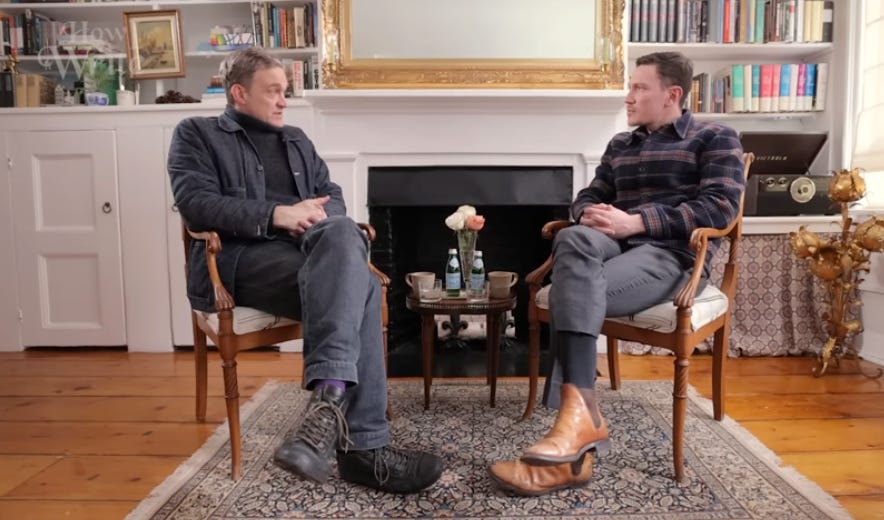
At first, I tried to tamp down my unease, like I had been doing for months. But a comment left on one instalment made the unsaid explicit. “Someone recommended me this podcast and the first thing I notice is all of… 4? female writers in a loong scroll down? Please more women interviewees”1.
Then I read the responses.
“Don’t mean this to sound rude [...]” said the first. “But I follow 7 writing podcasts and 5 of them are females and generally relate to female authors n everything from a female perspective. I don’t disagree with you but I think the writing space is shared pretty fairly”.
“The writing space is not shared fairly,” someone else replied. “Women are disproportionately favored in today’s market”.
Another: “No thanks, they’re insufferable”.
And finally: “This reason [...] is why we love this podcast. Female authors have a great amount of podcasts and show [sic] out there already”.
It was the tone that really got me. Aggrieved and defensive, transforming models originated to combat patriarchy — like the women-only space — into an UNO-reverse weapon of segregation.
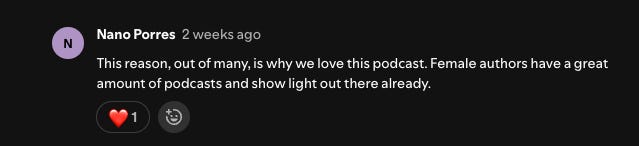
Women already have so much! Let us poor little boys have our thing. It crystalised a notable element of the men resurgence: victimhood.
I’d been considering the narrative arc of men according to a simple hero to villain pendulum swing. It was my boyfriend, ironically, who articulated the missing piece. “Victim,” he said, simply. “It’s gone hero, villain, victim”.
He was right. This was the new undertone I’d been picking up on. The whine of the perpetual victim.
Main character syndrome
I do believe men are victims — of patriarchy. But the current cultural expression of male victimhood positions them as casualties of the much vaguer ‘society’. Under its auspices, men are being left behind, frozen out and unfairly targeted. Their oppressors are vague and shifting, sometimes women, sometimes migrants taking jobs, sometimes just general ‘wokery’. It is a victimhood moulded by individualist grievance politics and spearheaded by right wing figures. Such sentiment is used to justify misogyny and a narrowing of collective focus back to men — their pain and pleasure — as necessary protectionist strategy.
A great example is an 2024 article by Financial Times data guru, John Burn-Murdoch, titled ‘Young women are starting to leave men behind’, which showed that women in the UK aged 20 to 24, were more likely to be in work or education than their male peers.
