In the tower

If you would like to support my writing, the best way to do that is by signing up as a paid subscriber to this Substack. It’s £3.50 per month which is very little on an individual basis but adds up to be a substantial relief for my strained finances and enables me to finish some large projects I’ve got on the go. Thank you in advance.
“But you’ve got a fella, don’t you?” asks Polly’s brother. He is 26 and has both the charm and linguistic inflections of Danny Dyer — a compliment of the highest order. We are all gathered in the smoking area of a south east London boozer to celebrate Polly’s birthday. I cackle with incredulous laughter in lieu of an answer. The concept of ‘a fella’ feels further away with every passing day.
This is not due to a poor market of men per se. Increasingly I believe the role that plays in my singlehood — three years and counting now, hardly noteworthy except for the fact I haven’t got within sniffing distance of a third date in that time — is far more minimal than I might have previously claimed. In short: it’s not them. It’s me.
It is hard to overstate just how much I suit being single, or think I do. This is because it is easier for me to be out of a relationship than in one; singlehood requires far less immediate and forcible confrontation of some very deep-rooted issues. Single, I can do my confronting at a more leisurely pace, in tandem with friends I have built deep trusting bonds with. Of course, there are some emotional nooks and crannies these platonic friendships can’t reach (and vice versa for romantic relationships). I suppose the question is, when — or if! — I will be willing to get the special duster out.
When I moved to Glasgow, I spent one weekend flicking through Hinge and then, without fanfare, deleted the app. This move turned out to be, if not permanent (I don’t want to jinx it), the longest period I have gone without using a dating app while single. I don’t see myself returning, not because I think apps are the root of all evil but because I simply don’t believe the model can overcome user dysfunction. And if you don’t believe in something to deliver, it won’t. If I meet someone, it will require — as I’ve previously outlined — an IRL connection and some good old fashioned frequent exposure. They call that a ‘slow burn’ nowadays, which I would push back on. It’s a perfectly reasonable pace. Think of how long it takes to build a friendship. Why do we expect — or want — a love connection to move at light speed?
Thing is, any romantic relation of mine will have trouble finding a speed full stop, or even starting the engine. When I consider the necessary and healthy compromise required to partake in a romantic relationship, I feel hot and trapped, fastforwarding past all the good bits to a vision of my hypothetical partner complaining I go to the gym too much or them getting the hump when I’m exhausted from work and don’t want to hang out. The thought of losing mastery — or at least the illusion of it — over my time, space, and emotions is panic inducing. I don’t think I am a heteropessimist per se, more a mix of a maladapted attachment style (who isn’t!) and unable to forget research that says, if you’re a heterosexual woman, the subgroup who are happiest and live longer are single and childfree.
That’s not because heterosexual relationships are innately bad for you, but because in the patriarchal world strand we inhabit, wives and mothers in such romantic pairings find both their health and emotional wellbeing impacted negatively at a higher rate than those going it alone.
“Nothing’s changed,” an older, childfree woman recently confided to me, as we sat aboard a train heading from Glasgow to London. She had been an investment banker in the 1980s, she explained, and although married, had chosen not to have kids for much the same reasons I am pretty sure I won’t: the simultaneous cultural fetishisation and material degradation of mothers is absolutely terrifying to behold. Those who are willing to brave it possess both far more courage than I do (right now, at least), and a much stronger maternal streak.
It’s telling that even theoretically entertaining the idea of a romantic relationship delivers me to ‘stuck at home with baby’ in the space of a few sentences. I have a beloved friend who can exchange a few words with a guy and immediately launch into daydreams of what menu would be served at their wedding. My malady is the opposite: all the sparkling things about building a shared world with someone that I would quite like actually — belly laughing in a dingy pub; swapping notes on a Tate Britain exhibition; feeling my shoulder carry the weight of their sleepy head as we undertake a long European train journey — are eclipsed by futuretripping, a great word gifted to me by a friend in a recovery programme, to describe the act of excessively obsessing over things all the way over the horizon.
Such hallucinations make me tremble. But they’re born of a parched romantic imagination. We’re always told that when something, or someone good comes along, you’ll know instinctively, be able to realise it. The mere existence of that person will spark some primal recognition, overriding all defence systems and hesitation. I think this is a myth (ditto: soulmates, sorry). That doesn’t mean I waste time regretting what I might have let ‘pass me by’ —I’ve already done it, so why all the handwringing? — but in recent months, there’s been an understanding take root that with battlements this high, not only would no one secure and sane possibly attempt to scale them, I also can’t see what golden opportunity might be standing outside.
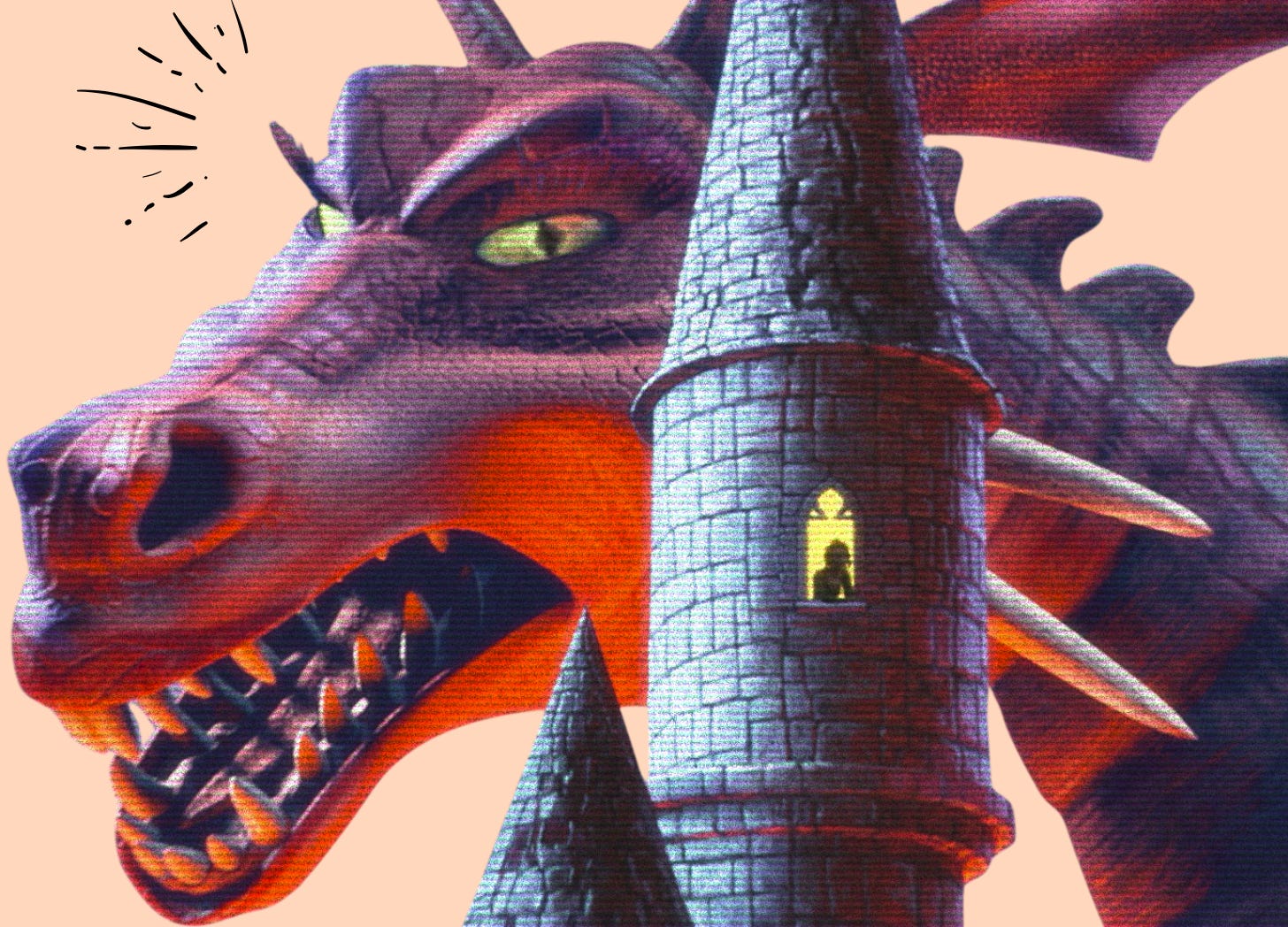
When you’ve got the drawbridge up AND the dragon at the gates, there’s almost certainly not going to be any prince coming to save you. Those potentially willing to breach the defences, however, are unboundaried, unwell people who feel comfortable shouldering past all the signs to KEEP OUT. At least in my experience.
I think these are questions of agency. At some point, when patterns persist in your romantic life, you have to turn the microscope upon yourself. Narratives like ‘it’s never me who’s chosen’ or ‘I’m unlovable’ rob us of power and relieve us of responsibility for any part we might be playing in a dynamic. It wouldn’t take a data journalist to pore over the people I’ve claimed to actually like over the last three years and conclude immediately they were remarkably unsuitable for any sort of solid partnership — obviously a big part of why I felt drawn to them over, say, the ones who clearly communicated they were ripe for pairing off.
Sure, I think there’s general twin crises of connection and commitment ongoing at the moment, although I’m not sure how new they are, only that the way these play out is different that they would have 20 years ago. But why for so long did I believe those phenomena to be things only other people were affected by? Why would internalising the idea that there’s something intrinsically wrong and repellent about me feel safer than acknowledging that I make my romantic choices from a place of avoidance? Picking the option that almost inevitably delivers low self-esteem is an act of shocking psychic self-harm. Surrendering my agency and blindly repeating such patterns over and over again, without interrogation, isn’t a protective measure but a waste of my precious time and energy.
I’m sure sometimes, it is them, not you. Yet if you’re anything like me, it’s so you that won’t even get to the stage where you find out it’s them. I’m not sure I’m completely ready to winch down the drawbridge just yet. But at least admitting my jailer wears my face is a start.